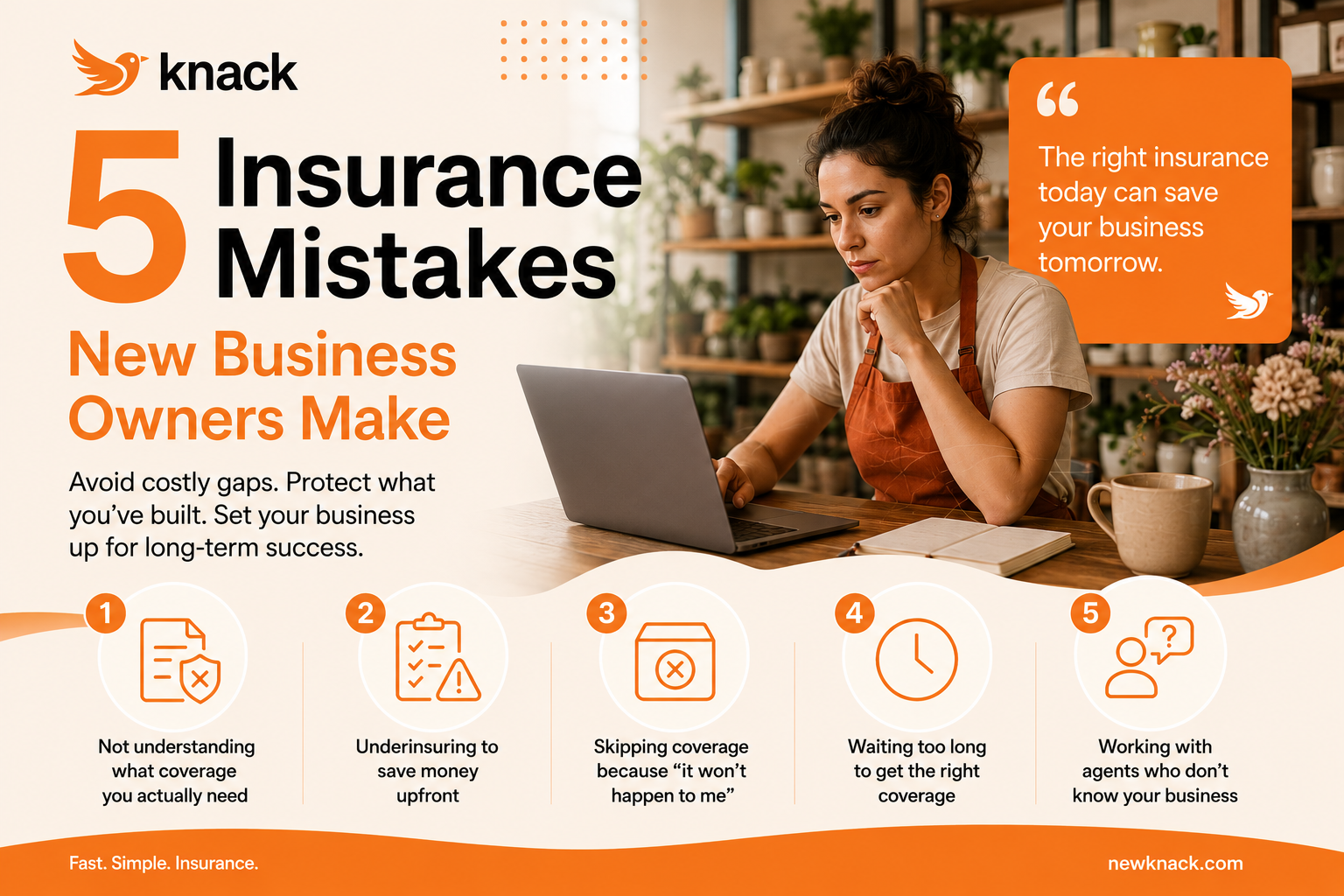
Mistake 1: Assuming Your Personal Insurance Has You Covered
A lot of people start their business while still holding personal insurance policies and assume there's enough overlap to get by. There isn't. Personal policies, whether it's your homeowner's, renter's, or personal umbrella, are not designed to cover business activity.
What happens if you host a client meeting at your home office and if a client trips coming in the door? Your homeowner's policy likely won't cover it if the visit was business-related. What happens if you use your personal vehicle to deliver products regularly? Your personal auto policy may deny the claim.
The fix is simple: treat your business as its own entity from day one. A basic General Liability policy can run a few hundred dollars a year. The lawsuit you avoid could cost ten times that.
Mistake 2: Buying the Minimum and Forgetting About It
Getting coverage is a good first step. Buying the lowest limit available and never revisiting it is where people run into trouble.
Insurance needs to grow with your business. If you started as a solo freelancer with a $300K liability policy and now you're running a team of five with a physical office space, you are underinsured. Full stop.
A few things that should trigger a coverage review:
You hired your first employee (or your fifth)
You signed a contract that specifies coverage requirements
You moved into a physical location
Your revenue grew significantly
You added a new service or product line
A good rule of thumb: review your policy every year at renewal and any time your business changes meaningfully.
Mistake 3: Not Knowing What You Actually Need
General Liability is the most common starting point, but it is not the whole picture for every business. The coverage you need depends on what your business does.
Here is a quick breakdown of where people get caught:
General Liability
Almost every business with clients or a physical presence.
Professional Liability (E&O)
Anyone giving advice or providing a service (consultants, designers, coaches).
Commercial Property
Anyone with equipment, inventory, or a leased space.
Workers' Comp
Required in most states the moment you hire someone.
Cyber Liability
Anyone storing client data, taking payments, or operating online.
If you're not sure which of these applies to your business, that conversation is worth having before something goes wrong.
Mistake 4: Choosing a Policy Based on Price Alone
The cheapest policy is not always the right or wrong policy. But buying purely on price without understanding what you're getting is a very common mistake with expensive consequences.
Ultra-low premiums usually come with trade-offs: lower coverage limits, narrower protection, or exclusions buried deep in the fine print. You might pay $200 less per year and then find out at the worst possible moment that your claim is not covered.
What to look at beyond the monthly cost:
What is the per-occurrence limit? (The max paid out for a single claim)
What is the aggregate limit? (The max paid out in a policy year)
Are there exclusions that apply to your specific type of work?
What is the deductible?
The goal is the right coverage at a fair price. Cheap insurance that does not pay out when you need it, is not insurance at all.
Mistake 5: Waiting Until a Client Requires It
This one happens constantly. A new business owner lands a bigger client, the contract comes over, and section 9 requires proof of General Liability insurance with a minimum $1 million per-occurrence limit. Now you're scrambling.
Scrambling leads to rushed decisions, which often means buying whatever is available quickly rather than what's right for your business. And if the client needs to be listed as an additional insured on your policy (also common), that takes time to set up.
Getting covered before you need it gives you options. You can compare policies, ask questions, and decide without a deadline hanging over you. It also signals to clients that you're a professional who has their house in order, which genuinely matters.
The Bottom Line
None of these mistakes are complicated. They all come down to the same thing: not giving insurance the attention it deserves until it's too late. The good news is that getting it right is not hard once you know what questions to ask.
Start with the right coverage for where your business is today. Review it as you grow. And do not wait for a client contract or a lawsuit to force the conversation.
See what coverage your business needs.
Get your free quote in minutes → https://newknack.com
Have questions about what makes sense for your situation? We're happy to walk you through it. No pressure, no complicated insurance talk.